

The passage explains the Next-Gen GST (Goods and Services Tax) reforms in India, which are part of a broader effort to simplify taxation and reduce the tax burden on citizens, especially during Diwali, a major festival in India. Here’s a clear breakdown of what the passage is explaining:
1. What is the Next-Gen GST?
The Next-Gen GST is a reform of the Goods and Services Tax (GST), which is a comprehensive indirect tax on goods and services in India. The goal of the reforms is to simplify the tax system, reduce the tax burden on consumers, and support small businesses and farmers.
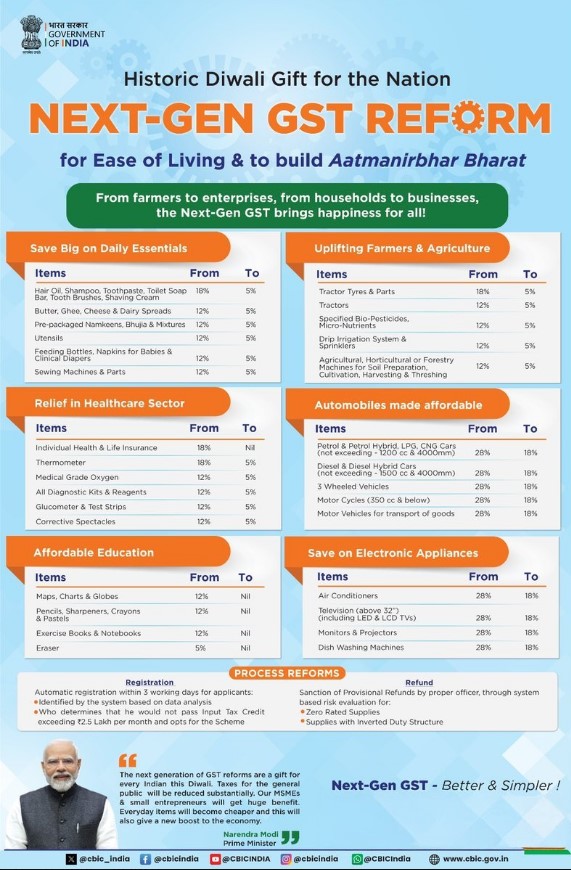
2. Key Benefits of the Reforms
-
Reduced Tax Rates: Many everyday items, such as toothpaste, shampoo, hair oil, butter, ghee, and cheese, have seen a reduction in tax rates from 18% to 5%. This makes these essential goods cheaper for consumers.
-
Support for Farmers: Agricultural items like tractors, tractor tyres, and drip irrigation systems have also seen tax reductions. This helps support farmers and improve agricultural productivity.
-
Health and Medical Sector: Items like thermometers, medical-grade oxygen, and glucometers have lower tax rates, making healthcare more affordable and accessible.
-
Automobiles: The tax on petrol, diesel, and vehicles has been reduced, making automobiles more affordable for the general public.
-
Education and Office Supplies: Items like pencils, erasers, and exercise books have lower tax rates, reducing the cost of educational and office supplies.
-
Electronics: Products like air conditioners, televisions, and monitors have also seen tax reductions, making these items more affordable for consumers.
3. Simplification and Benefits for Small Businesses
- The reforms aim to make the GST system simpler and more efficient, reducing the administrative burden on small businesses and micro-enterprises.
- This helps small entrepreneurs and MSMEs (Micro, Small, and Medium Enterprises) to save money and grow their businesses.
4. Overall Impact
- The tax burden on the general public is reduced, making everyday items cheaper.
- This leads to lower prices for consumers, which is especially beneficial during Diwali, a time when people often buy gifts and household items.
- The reforms are part of a larger effort to build a self-reliant India (Aatmanirbhar Bharat), by making the economy more efficient and inclusive.
5. Conclusion
The Next-Gen GST reforms are a major step towards making India’s economy more efficient, affordable, and inclusive. By reducing tax rates on essential goods and services, the reforms aim to benefit all sections of society, from farmers and small businesses to everyday consumers. This is especially highlighted during Diwali, a time when the government wants to bring joy and affordability to the public through tax reforms.